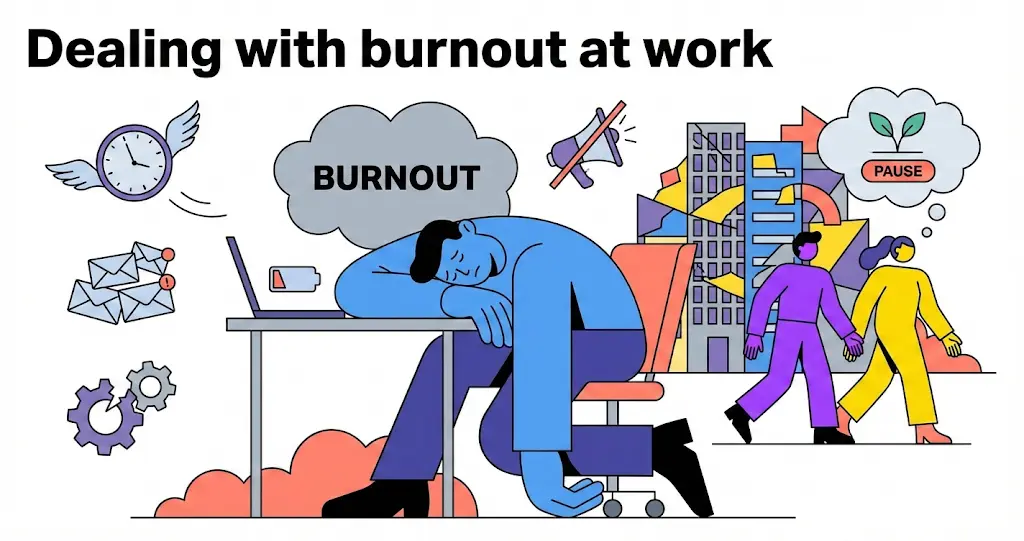
Burnout isn't just being tired—it's exhaustion that rest alone won't fix. Take the self-assessment, find out what's driving it, and make a plan.
Burnout isn't just being tired. It's a specific kind of exhaustion that rest alone won't fix. Here's how to recognize it, understand what's causing it, and actually do something about it.
Let me describe a feeling and you tell me if it sounds familiar.
You used to care about your work. Maybe even loved it. But somewhere along the way, the fire went out. Not dramatically — not a blowout or a breakdown. More like a slow leak. You're still showing up, still hitting deadlines, still saying "I'm fine" in meetings. But inside? Nothing. Just a flat, gray numbness that makes everything feel like it takes twice the effort for half the result.
If that landed, keep reading.
Burnout is not the same as being tired
This distinction matters, because the fix for tiredness is rest — and rest alone doesn't fix burnout.
Being tired means you need a vacation. Burnout means you could take a two-week vacation, feel great for three days back at work, and then be right back where you started by Friday.
The World Health Organization classifies burnout as an "occupational phenomenon" with three dimensions:
- Exhaustion — you're running on empty, physically and emotionally
- Cynicism — you've detached from your work, your team, maybe your whole career
- Reduced efficacy — you feel like you're bad at your job, even if the evidence says otherwise
If you're just exhausted, that's one thing. If you've got all three? That's burnout. And it requires a different approach than "take a long weekend."
The burnout self-assessment
I use a version of this with coaching clients. It's not a clinical diagnosis — for that, talk to a therapist or your doctor. But it helps you see clearly what you're dealing with so you can do something about it.
For each statement, rate yourself 1 to 5. (1 = not at all, 5 = that's exactly me right now.)
Energy and exhaustion
- I feel physically drained by the end of most workdays — not just tired, but depleted.
- I have trouble sleeping because of work-related thoughts, even when I'm exhausted.
- I get sick more often than I used to (headaches, colds, stomach issues).
- The idea of starting my workday fills me with dread, not just reluctance.
- I can't remember the last time I had genuine energy for a work project.
Cynicism and detachment
- I've stopped caring about the quality of my work — "good enough" has become "whatever."
- I feel emotionally disconnected from my coworkers and team.
- I find myself mentally checked out during meetings, even important ones.
- I'm increasingly sarcastic or negative about work, even with people I like.
- Company goals, mission statements, and team initiatives feel meaningless to me.
Efficacy and confidence
- I doubt my ability to do my job well, even though I used to feel competent.
- I've been making more mistakes than usual and catching them too late.
- I avoid taking on new challenges because I don't trust myself to deliver.
- Feedback — even positive feedback — doesn't land. I either don't believe it or don't care.
- I feel like I'm falling behind, even when I'm objectively keeping up.
How to read your score
15–30: You're stressed, but probably not burned out. You might need better boundaries, a lighter workload, or a vacation. The strategies in the "quick fixes" section below should help.
31–50: You're in the danger zone. Burnout is either setting in or already here. The "structural changes" section is for you — and you should seriously consider talking to someone (a coach, a therapist, or both).
51–75: You're burned out. This isn't a willpower problem and it won't fix itself. You need real changes — to your role, your environment, or both. Read the whole post, and please reach out to a professional.
What's actually causing it
Here's where burnout gets tricky. The symptoms all feel the same, but the causes can be wildly different. And the fix depends entirely on the cause.
I see five common drivers in coaching. Most folks have two or three stacked on top of each other.
1. Workload (the obvious one)
You're doing too much. Too many projects, too many meetings, too many Slack messages, too many "quick favors" that are never quick. There's more work than hours, and the gap keeps growing.
This one is the easiest to diagnose and — in theory — the most fixable. In theory. Because the problem is usually not that the work exists, but that nobody's willing to say "no" or "not yet" or "we need to cut something."
I've written about the always-on culture that creates this. Artificial urgency is a burnout machine.
2. Lack of control
You're not overwhelmed by the amount of work — you're overwhelmed by the fact that you have zero say in how it gets done. Your schedule is dictated by meetings you didn't call. Your priorities shift every time your boss talks to their boss. You're executing someone else's plan with no input.
Autonomy is a basic human need. When it's stripped away at work, even manageable workloads become unbearable.
3. Values mismatch
The company says one thing and does another. They talk about "people first" but reward overwork. They preach innovation but punish risk. You joined because you believed in the mission, and now you realize the mission was a recruitment pitch.
This is the one that creates the deepest cynicism. You can survive long hours. It's much harder to survive working for something you don't believe in.
4. Insufficient recognition
You're doing excellent work and nobody seems to notice. No feedback, no promotions, no acknowledgment. The message you receive — whether or not it's intended — is that your contribution doesn't matter.
Over time, that erodes your motivation to the point where you stop trying. Why give 100% when 60% gets exactly the same response?
5. Toxic relationships
A bad manager. A manipulative coworker. A team dynamic that's all politics and no trust. If your daily work involves navigating people who drain you, that's a burnout accelerant.
I deal with this one a lot in coaching — bad managers are one of the single biggest drivers of burnout. And they're often the hardest to change.
What to do about it (the practical part)
Quick fixes (if you caught it early)
These won't cure burnout, but they can stop the bleeding while you work on bigger changes.
Protect your mornings. Block the first hour of every day as "no meetings" time. Use it for the work that matters most — before your energy gets eaten by other people's priorities.
Audit your calendar. Go through your meetings for the next two weeks and decline everything that doesn't require your specific input. Not "could benefit from your perspective" — requires your specific input. I promise at least 30% of your meetings don't need you.
Set one hard boundary this week. Not five. Not a whole new system. Just one. Maybe it's not checking email after 7 PM. Maybe it's taking an actual lunch break. Maybe it's saying "I can't take that on right now" to one request. Start small and prove to yourself that the world doesn't end.
Move your body. I know this sounds like generic wellness advice, but the research is annoyingly clear on this one. Even a 20-minute walk changes your brain chemistry enough to interrupt the burnout cycle. You don't need a gym membership. You need shoes.
Structural changes (if it's deeper than a bad week)
Have the conversation with your manager. Not "I'm burned out" — that puts them on the defensive. Instead: "I want to talk about my workload and priorities. I'm at capacity and I want to make sure I'm focused on the right things."
This reframes burnout as a resource allocation problem, which is something managers can actually solve. Most managers would rather have a conversation now than deal with your resignation later.
Renegotiate your role. Sometimes burnout comes from role drift — you've gradually taken on responsibilities that weren't part of the original deal, and now you're doing a job you never agreed to. Sound familiar? (It did for our project manager friend who hated their job.)
If this is you, it's worth having an explicit conversation: "Here's what I was hired to do. Here's what I'm actually doing. Can we talk about what belongs on my plate and what doesn't?"
Build recovery into your routine. Not a vacation once a year — regular, weekly recovery. A day with no work. An evening you protect fiercely. A hobby that has nothing to do with productivity. Burnout recovery isn't a one-time event. It's a rhythm.
Consider whether the environment will change. This is the hardest question. If your burnout is driven by workload, you might be able to fix it within your current job. If it's driven by values mismatch or toxic leadership, no amount of boundary-setting will solve it. The environment is the problem, and you might need to change the environment.
If you're at that point, the career transition guide can help you think through what a move looks like.
If none of this is enough
Talk to a professional. And I don't mean just a coach — I mean a therapist. Burnout that's been going on for months can start to look and feel like depression. And sometimes it literally becomes depression. There's no shame in that, and there's nothing I can do as a coach that replaces what a good therapist provides.
(Not sure which one you need? I wrote a breakdown of career coaching vs. therapy to help you figure that out.)
The permission you might need
Here's the thing I tell almost every burned-out client: you are not lazy, and this is not a character flaw.
Burnout is what happens when a capable person works in a system that takes more than it gives back — for too long. It's a structural problem, not a personal one. You don't need more discipline, more hustle, or a better morning routine. You need the conditions to change.
Sometimes you can change the conditions from within. Sometimes you need to change the environment entirely. Either way, the first step is the same: take it seriously.
Here's Pete's blessing: you have permission to stop running on empty. Not because you'll break — but because you deserve better than just surviving your workdays. And "good enough" includes taking care of yourself.