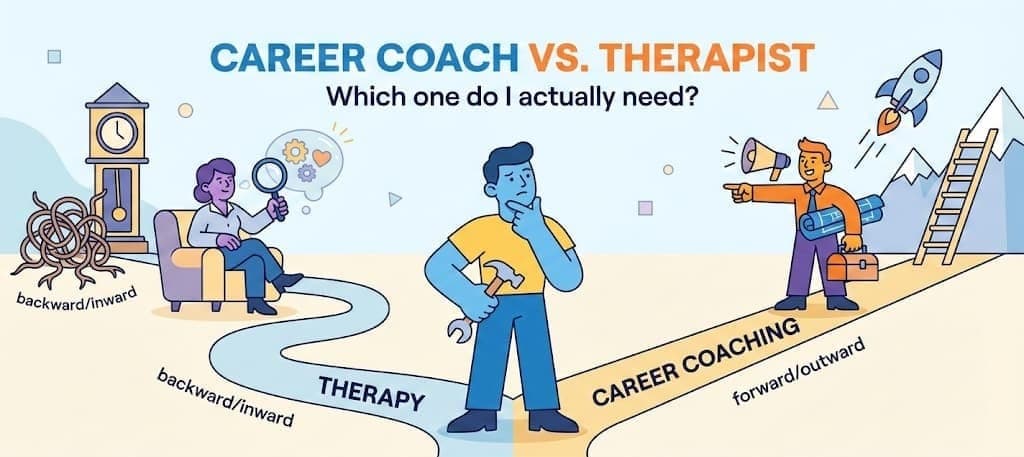
They're not the same thing. A therapist looks backward and inward. A coach looks forward and outward. Here's how to find out which one you need.
They're not the same thing. They're not interchangeable. And getting this wrong means spending time and money on the wrong kind of help. Here's how to tell which one fits your situation.
I get this question constantly — usually phrased as "should I see a coach or a therapist?" — and my answer is always the same.
It depends on the problem.
Not a satisfying answer, I know. But it's the honest one. Career coaching and therapy are different tools that solve different problems, and using the wrong one is like bringing a hammer to a screw. You'll make some noise, but you won't fix anything.
So let me help you figure out which tool you actually need. And in some cases, the answer might be both.
The fundamental difference
Here's the simplest way I can frame it:
Therapy looks backward and inward. It helps you understand why you feel and behave the way you do. It works through past experiences, patterns, emotional responses, and mental health conditions. The goal is healing, self-understanding, and emotional regulation.
Coaching looks forward and outward. It helps you figure out what to do next and how to do it. It works with your current situation, your goals, and the practical obstacles in your way. The goal is action, strategy, and measurable progress.
Both are valuable. Neither is superior. They're just pointed in different directions.
When you need a therapist
Your mental health is the primary issue. If you're dealing with clinical anxiety, depression, PTSD, or any diagnosable condition — a therapist is who you need. Full stop. No amount of career strategy helps if your brain chemistry is working against you.
You're in crisis. If you're having panic attacks at work, can't get out of bed, or are having thoughts of self-harm — please see a therapist, not a coach. This isn't a career problem with a career solution.
The patterns go deeper than work. If you've had the same problem at every job — toxic relationships with every boss, constant conflict with coworkers, a pattern of self-sabotage right before a promotion — there might be something underneath the work stuff that needs attention. A therapist can help you see those patterns and work through their roots.
You need to process something. A layoff that left you shaken. A workplace that traumatized you. A career failure that you can't stop replaying. Processing emotion is therapy's wheelhouse. Coaching will try to move you forward before you've dealt with what's holding you back.
The problem started before the job. If your relationship with work is tangled up with childhood experiences, identity, self-worth, or family dynamics — that's therapy territory. These are deep roots that require deep work.
When you need a career coach
You know what's wrong, but don't know what to do about it. You hate your job. You want a career change. You got promoted and you're floundering. The problem is clear — you just need a plan. That's coaching.
You need practical strategy. How to negotiate a raise. How to navigate a difficult manager. How to transition into a new industry without starting over. How to position your résumé for a career change. These are concrete, tactical problems, and a coach is built for exactly this.
You're stuck but not broken. There's a big difference between "I feel stuck in my career and I need help figuring out my next move" and "I feel stuck in my life and I can't function." The first is coaching. The second is therapy. If you're not sure which one you are, lean toward therapy — you can always add coaching later.
You need accountability. A therapist will help you understand your avoidance patterns. A coach will text you on Thursday and ask if you sent those five networking emails you committed to. Both are useful, but accountability is a core coaching feature.
You want to build specific skills. Management, communication, boundary-setting, salary negotiation, executive presence — these are learnable skills, and coaching is essentially skill-building with a personalized curriculum.
When you need both
This is more common than most people think. And there's no shame in it.
The classic "both" scenario looks like this: you're burned out at work (the situation needs to change — that's coaching), and the burnout has tipped into anxiety or depression (your mental health needs support — that's therapy). One professional helps you change the conditions. The other helps you heal from the damage those conditions have done.
Another common one: you want to make a career change (coaching), but every time you get close to making a move, something stops you — fear, self-doubt, a voice in your head that says you don't deserve it (therapy).
When both are in play, the two professionals don't need to talk to each other (though they can, with your permission). They're working on different layers of the same problem, and progress in one tends to accelerate progress in the other.
The comparison at a glance
| | Therapist | Career coach | |---|---|---| | Focus | Why you feel and behave this way | What to do next and how | | Time orientation | Past and present | Present and future | | Primary goal | Healing, self-understanding | Action, strategy, results | | Deals with | Mental health, trauma, emotional patterns | Career decisions, skill-building, workplace challenges | | Credentials | Licensed (LCSW, LPC, PhD, PsyD) | Certified (ICF, various programs) — varies widely | | Session frequency | Usually weekly | Usually biweekly or monthly | | Duration | Ongoing, often months to years | Typically 3–6 months for a specific goal | | Insurance | Often covered | Rarely covered | | Accountability | Not the primary focus | A core feature |
How to pick the right one for you
Here's a quick gut check. Read these two statements and see which one resonates more:
A: "I need to understand why I keep ending up in the same situation. Something inside me is driving a pattern I can't seem to break."
B: "I know what I want to change. I just need help building a plan and someone to keep me on track."
If A hits harder, start with therapy. If B hits harder, start with coaching. If both hit — start with therapy, add coaching when you're stable enough to take action.
And here's the thing I always tell folks: starting with one doesn't lock you into it forever. You can begin with therapy, work through the deeper stuff, and then bring in a coach when you're ready to make moves. Or you can start with coaching, realize there's something underneath the career problem, and add a therapist. The path doesn't have to be linear.
A note on credentials
I want to be transparent about something, because this industry can be murky.
Therapists are licensed. They've completed graduate programs, thousands of hours of supervised clinical work, and passed licensing exams. LCSW, LPC, LMFT, PsyD, PhD — these letters mean something specific and are regulated by the state.
Coaching is unregulated. Anyone can call themselves a career coach. There's no required credential, no licensing board, no minimum training. The International Coaching Federation (ICF) offers the most widely respected certifications, and many good coaches have them — but many good coaches also don't.
This doesn't mean coaching is less valuable. It means you need to do your homework. Ask about their background, their experience, their approach. A great coach with real-world management experience and strong references is worth every penny. A "coach" who took a weekend course and hung up a shingle? Less so.
The bottom line
You don't need to have this figured out before you reach out to someone. Most therapists and coaches offer an initial consultation — use it. Tell them what you're dealing with and let them help you determine if they're the right fit. A good therapist will tell you if you need coaching instead. And a good coach — hi, that's me — will tell you if you need therapy instead.
I've done it plenty of times. No ego about it. The goal is getting you the right help, not selling you mine.
Here's Pete's blessing: asking for help is the most competent thing you can do. Whether that's a therapist, a coach, or both — the fact that you're looking for support means you're taking your situation seriously. That's not weakness. That's the smartest move you've made in a while.